
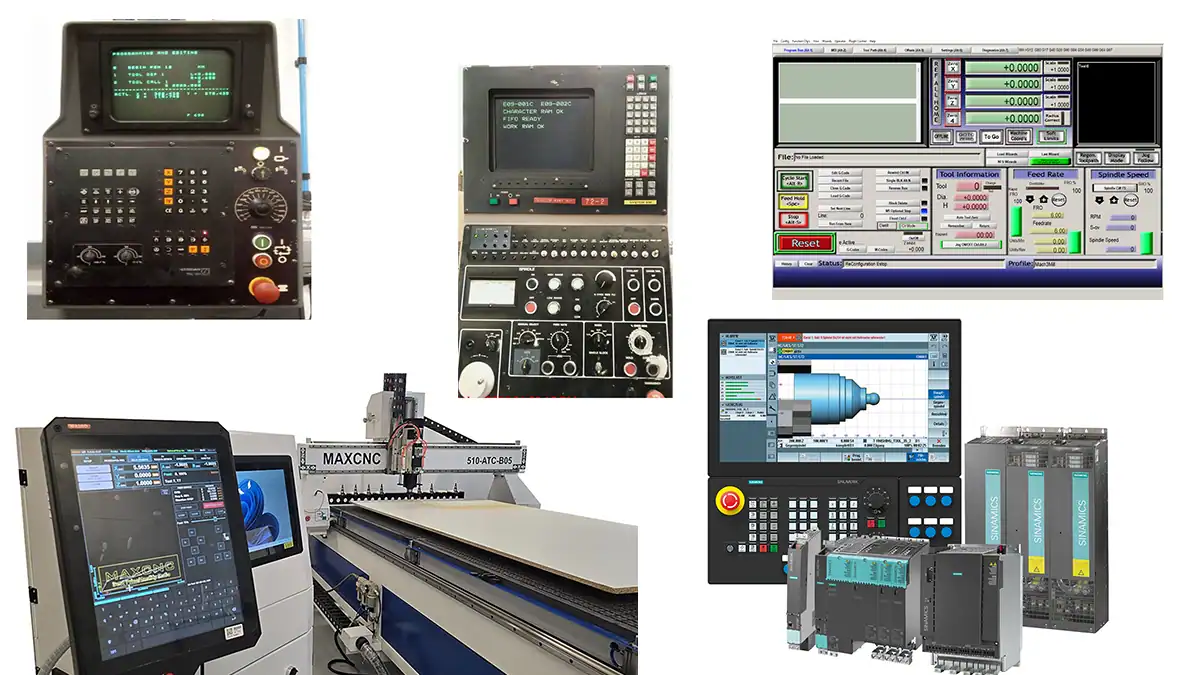
A CNC controller is used to control the motion and position of two or more machine axes based on a series of commands or a G-code program. To achieve accurate motion, the axes must be interpolated linearly or circularly, ensuring smooth and synchronized movement between all axes.
Selecting the right CNC controller depends heavily on the application requirements. In general, CNC controllers can be divided into two main categories:
Open-Loop Controllers
Open-loop controllers are generally more cost-effective and easier to install and commission. These systems do not receive direct real-time position feedback from the machine axes. However, modern servo drives can internally close the loop, allowing the overall system to achieve excellent performance even when used with an open-loop controller.
Open-loop systems became very popular in CNC routers, plasma cutters, laser machines, and many light industrial applications.
Advantages
- Lower cost
- Simpler wiring and setup
- Easier commissioning
- Good performance for many applications
Disadvantages
- Less direct control over actual axis position
- Reduced fault detection compared to true closed-loop systems
Closed-Loop Controllers
Closed-loop controllers receive real-time feedback from devices such as encoders or resolvers. The CNC controller continuously monitors and corrects axis position errors during operation.
These systems are generally more accurate and suitable for demanding industrial applications, but they are also more expensive and more complex to install and commission.
Advantages
- High positioning accuracy
- Better motion control
- Improved fault monitoring
- Suitable for high-performance industrial machinery
Disadvantages
- Higher cost
- More complex integration
- More difficult commissioning and troubleshooting
Early Industrial CNC Controllers
In the early days of CNC technology, most CNC controllers were expensive closed-loop systems manufactured by large industrial companies such as:
- Siemens
- GE Fanuc
- HEIDENHAIN
- Fagor Automation
These systems required position feedback to operate correctly. Feedback signals were typically provided either directly from the servo drive or through separate encoders or resolvers installed on the machine.
Communication methods between the controller and servo drives varied significantly over the years, including:
- Analog voltage/current control
- Dedicated high-speed drive buses
- Fieldbus systems such as PROFIBUS
- Modern industrial Ethernet systems
Many manufacturers also designed proprietary systems that only worked properly with their own servo drives and hardware, forcing customers to remain within a single vendor ecosystem.
The Rise of Open-Loop CNC Systems
As AC servo motors became faster, more reliable, and more affordable, the CNC market started to change dramatically.
Standard communication methods such as:
- Pulse/Direction (Pulse Train)
- Step/Direction
- EtherCAT
- Ethernet-based motion control
became increasingly common and opened the door for more affordable CNC systems.
At the same time, many CNC router manufacturers — especially early Chinese CNC router builders — adopted open-loop architectures using stepper motors and low-cost controllers. Although these systems lacked full closed-loop feedback at the controller level, they were sufficient for many woodworking, signage, and light manufacturing applications.
The Mach3 Revolution
One major turning point in the CNC industry was the release of Mach3 by ArtSoft.
Before Mach2 and Mach3, many companies and hobbyists attempted to develop DOS-, Windows-, or Linux-based CNC control systems using custom ISA or PCI interface cards. Most of these systems were expensive, proprietary, or difficult to configure.
Mach3 changed the industry by using a standard PC parallel port (LPT1) together with Windows-based software, allowing ordinary computers to function as CNC controllers.
This was revolutionary at the time.
Later, many companies developed motion interface boards that used USB or Ethernet communication instead of the older parallel port, allowing Mach3 to remain relevant long after LPT ports disappeared from modern computers.
Even today, many machines around the world still operate reliably using Mach3-based systems.
Modern CNC Controllers
Today, the CNC controller market is flooded with options ranging from low-cost hobby controllers to advanced industrial systems.
Modern controllers may support:
- EtherCAT motion control
- Servo synchronization
- Tool changers
- Multi-axis interpolation
- Remote diagnostics
- PLC integration
- Industrial networking
The challenge today is no longer finding a CNC controller — it is selecting the correct controller for the application.
Factors such as:
- Machine type
- Required accuracy
- Budget
- Ease of maintenance
- Expandability
- Available technical support
- Integration requirements
all play an important role in choosing the right system.
Final Thoughts
There is no single “best” CNC controller for every application. A controller that works perfectly for a woodworking CNC router may not be suitable for a high-speed machining center or a complex production line.
Understanding the history and evolution of CNC controllers helps machine builders and end users make better decisions when selecting control systems for modern machinery.
At PLC24, we work with a wide range of CNC control technologies, from legacy systems to modern industrial automation platforms, helping customers upgrade, troubleshoot, and optimize their machines for long-term reliability and performance.